Meta Description: Indian Constitution basics for UPSC and IAS: explore key features, rights, duties, amendments and important facts.
Meta Description: Indian Constitution basics for UPSC and IAS: explore key features, rights, duties, amendments and important facts.
1 Powerful Indian Constitution Basics: Key Facts Every UPSC/IAS Aspirant Must Know
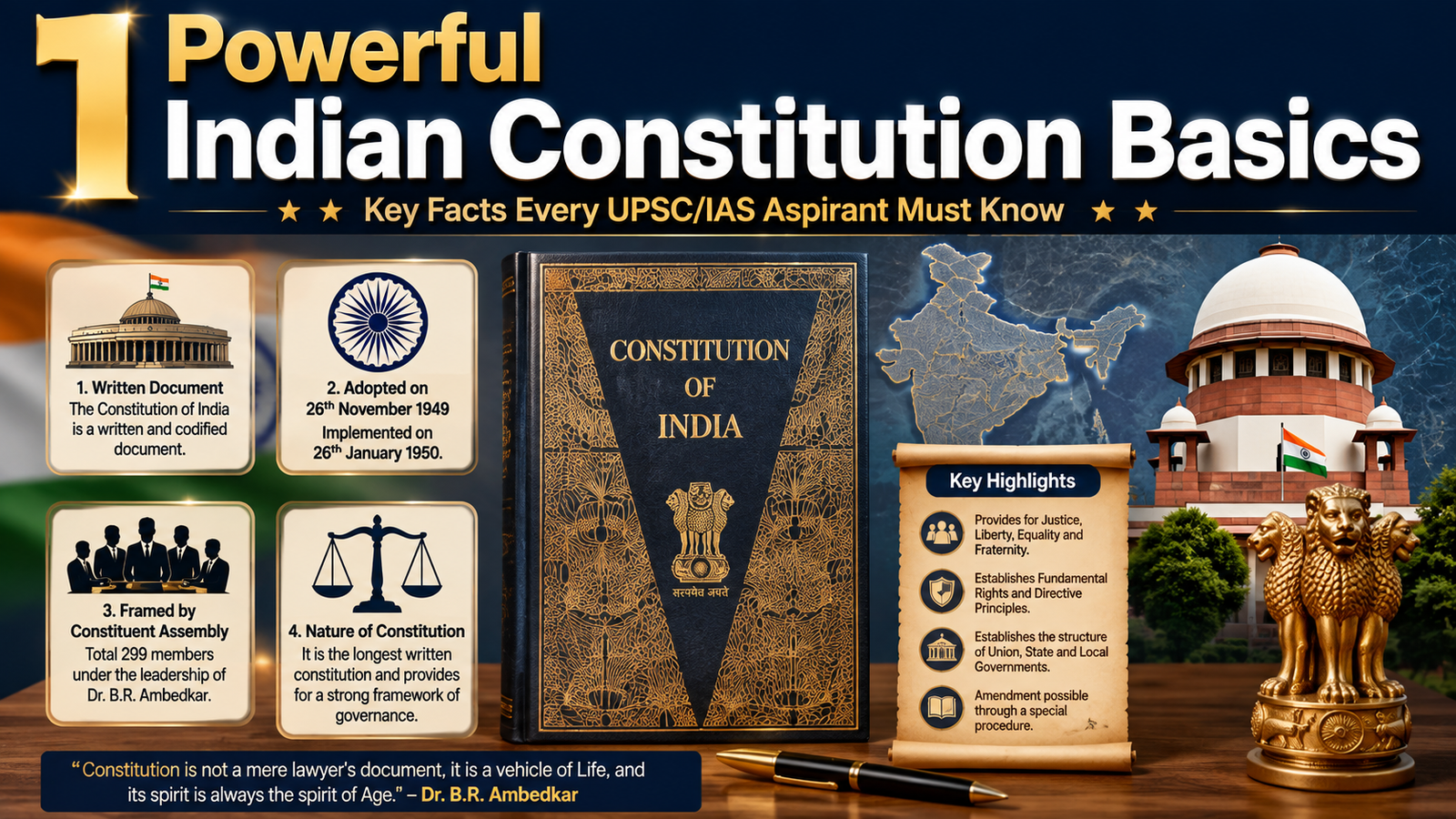
The Constitution of India is not merely a legal document; it is the fundamental law of the land, serving as the cornerstone of Indian democracy, governance, and civil rights. Adopted on 26th November 1949 and coming into force on 26th January 1950, it holds the distinction of being the longest written constitution of any sovereign nation in the world. For aspirants preparing for competitive examinations such as UPSC Civil Services and IAS, mastering these foundational principles is critical. As Dr. B.R. Ambedkar famously noted, “Constitution is not a mere lawyer’s document, it is a vehicle of Life, and its spirit is always the spirit of Age.”
1 Powerful Indian Constitution Basics: Key Points from the Visual Overview
- 1. Written Document: The Constitution of India is a written and codified document detailing all rights, duties, and state structures.
- 2. Historical Timeline: Adopted on 26th November 1949 and implemented on 26th January 1950.
- 3. Framed by Constituent Assembly: Created by a total of 299 members under the leadership of Dr. B.R. Ambedkar.
- 4. Nature of Constitution: It is the longest written constitution in the world, providing a strong and resilient framework of governance.
- Preamble Goals: Guarantees Justice, Liberty, Equality, and Fraternity.
- Core Mechanisms: Establishes Fundamental Rights, Directive Principles, three-tier governance (Union, State, Local), and special amendment procedures.
1 Powerful Indian Constitution Basics: Historical Background and Evolution
Understanding the foundation of the Indian Constitution requires tracing its roots through colonial administrative reforms and the Indian national freedom struggle.
- Regulating Act of 1773 to Charter Acts: Early steps laid the groundwork for centralized administration in British India.
- Government of India Act 1919 and 1935: Introduced provincial autonomy, bicameralism, and division of powers between the centre and provinces, acting as the structural blueprint for the 1950 document.
- The Constituent Assembly: Formed in 1946 under the Cabinet Mission Plan, the Constituent Assembly comprised 299 members who took 2 years, 11 months, and 18 days to draft the final text under Dr. B.R. Ambedkar’s guidance.
1 Powerful Indian Constitution Basics: Core Structural Features
The Indian Constitution stands out globally due to its unique balance of rigidity, flexibility, and federal structure with a centralizing orientation.
Lengthiest Written Constitution
Unlike unwritten constitutions (such as the United Kingdom’s), India’s Constitution comprehensively covers federal and state structures, emergency provisions, local governance, civil service administration, and judicial hierarchies.
Blend of Rigidity and Flexibility
Amendments can be made through a simple majority, a special majority in Parliament, or a special majority combined with ratification by half of the state legislatures under Article 368.
Federal System with Unitary Bias
While establishing a federal structure with a clear division of power across Union, State, and Concurrent lists, the Constitution includes unitary features during national emergencies or through mechanisms like the appointment of Governors and a unified judiciary.
1 Powerful Indian Constitution Basics: The Preamble as the Soul
The Preamble summarizes the philosophy, objectives, and values of the nation.
- Source of Authority: “We, the People of India…” emphasizes popular sovereignty.
- Nature of the Indian State: Declares India to be a Sovereign, Socialist, Secular, Democratic, Republic.
- Core Objectives: Guarantees Justice (social, economic, political), Liberty (thought, expression, belief, faith, worship), Equality (status and opportunity), and promotes Fraternity while maintaining individual dignity and national unity.
1 Powerful Indian Constitution Basics: Fundamental Rights (Part III)
Fundamental Rights act as a shield against arbitrary state action, ensuring political democracy and individual freedom. Guaranteed under Articles 12 to 35, they are legally enforceable through writs.
- Right to Equality (Articles 14–18): Guarantees equality before law, prohibition of discrimination, equality of opportunity in public employment, and abolition of untouchability and titles.
- Right to Freedom (Articles 19–22): Protects freedom of speech, assembly, association, movement, residence, and profession, along with life and personal liberty under Article 21.
- Right against Exploitation (Articles 23–24): Prohibits human trafficking, forced labor, and child labor in hazardous occupations.
- Right to Freedom of Religion (Articles 25–28): Guarantees freedom of conscience, practice, propagation, and management of religious institutions.
- Cultural and Educational Rights (Articles 29–30): Protects minority scripts, languages, and rights to establish educational institutions.
- Right to Constitutional Remedies (Article 32): Considered by Dr. B.R. Ambedkar as the “heart and soul” of the Constitution, empowering citizens to approach the Supreme Court via writs like Habeas Corpus, Mandamus, Prohibition, Certiorari, and Quo-Warranto.
1 Powerful Indian Constitution Basics: Directive Principles of State Policy (Part IV)
Articles 36 to 51 outline the Directive Principles of State Policy (DPSP). While non-justiciable (not enforceable in a court of law), they remain fundamental in governance and aim to establish socio-economic democracy.
- Socialistic Principles: Focus on reducing wealth concentration, securing adequate means of livelihood, and ensuring equal pay for equal work.
- Gandhian Principles: Promote village panchayats, cottage industries, and prohibition of intoxicating drinks.
- Liberal-Intellectual Principles: Advocate for a Uniform Civil Code (Article 44), free primary education, separation of executive from judiciary, and international peace.
1 Powerful Indian Constitution Basics: Fundamental Duties (Part IV-A)
Incorporated by the 42nd Constitutional Amendment Act in 1976 on the recommendation of the Swaran Singh Committee (and expanded by the 86th Amendment in 2002), Article 51A outlines 11 Fundamental Duties.
- Respect the Constitution, National Flag, and National Anthem.
- Cherish noble ideals of the national freedom struggle.
- Uphold and protect the sovereignty, unity, and integrity of India.
- Defend the country and render national service when required.
- Safeguard public property and abjure violence.
- Provide educational opportunities to children aged 6 to 14 years.
1 Powerful Indian Constitution Basics: Governance and Separation of Powers
The Constitution institutes a parliamentary system at both Union and State levels, promoting co-operation between the legislature and executive while keeping the judiciary independent.
| Branch | Primary Role | Key Authorities |
| Legislature | Enacting laws and holding executive accountable | Parliament (Lok Sabha & Rajya Sabha), State Assemblies |
| Executive | Implementing laws and day-to-day administration | President, Prime Minister, Union Cabinet, Governors |
| Judiciary | Interpreting laws and resolving legal disputes | Integrated System: Supreme Court, High Courts, Subordinate Courts |
1 Powerful Indian Constitution Basics: Key Amendments and Basic Structure Doctrine
The amendment mechanism allows the Constitution to adapt over time while protecting its core framework.
Important Amendments
- 1st Amendment (1951): Added the Ninth Schedule to shield land reform laws from judicial review.
- 42nd Amendment (1976): Termed the “Mini-Constitution,” added “Socialist,” “Secular,” and “Integrity” to the Preamble, along with Fundamental Duties.
- 44th Amendment (1978): Reversed several emergency provisions and strengthened civil liberties.
- 73rd & 74th Amendments (1992): Granted constitutional status to Panchayati Raj Institutions and Urban Municipalities.
- 101st Amendment (2016): Introduced the Goods and Services Tax (GST) framework.
Basic Structure Doctrine
Established in the historic Kesavananda Bharati v. State of Kerala (1973) case, the Supreme Court held that Parliament’s power to amend under Article 368 does not extend to altering or destroying the “Basic Structure” of the Constitution, such as secularism, federalism, judicial review, and rule of law.



Leave a Reply